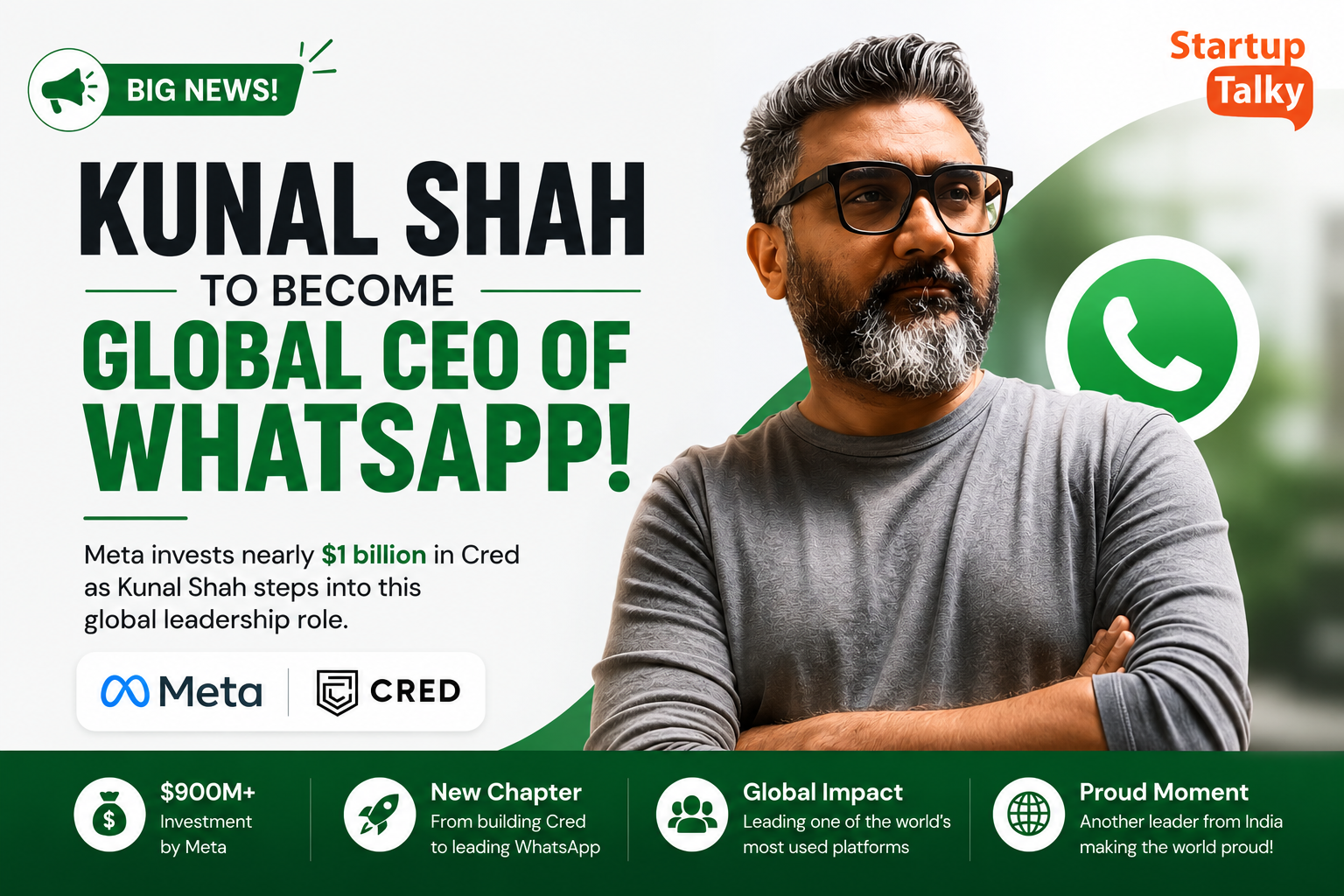
The man who will run WhatsApp has never run a messaging product.
Kunal Shah built FreeCharge, sold it, then built CRED, a members-only app that rewards people for paying their credit-card bills. On 22 June 2026, Meta named him the next global head of WhatsApp, replacing Will Cathcart, who is stepping down after roughly seven years and moving into a new Meta role focused on building consumer products with AI tools.
The man he replaces is the opposite of him on paper. Cathcart is a career Meta product executive who ran the world's largest communication service through seven years of scale and regulation. Shah is an external founder whose biggest product, CRED, has around 17 million members. WhatsApp has more than three billion. That is not a promotion. It is a category change.
So the interesting question is not whether Shah is qualified to run a messaging app. It is why Meta decided the person running WhatsApp next should be a consumer-fintech founder rather than a messaging executive. The answer is the actual news here.
What the CRED–Meta deal actually is
On 22 June 2026, CRED announced it will raise approximately $900 million (around ₹8,550 crore) from Meta Platforms as part of its Series H round, at a post-money valuation of $4.5 billion (roughly ₹43,239 crore).
The structure is a mix of primary capital and secondary share purchases, with a portion of the money buying out shares held by existing CRED investors. Meta takes an approximately 20% minority stake in the Bengaluru company, with no board seat and, the parties have stressed, no access to member data.
Alongside the cheque comes the leadership change. Shah steps down from his operating role as CRED's CEO to join Meta as a full-time employee and lead WhatsApp globally. Miten Sampat, who has led strategy and finance at CRED since 2020, becomes interim CEO while the board works on succession. Shah keeps his equity and remains a shareholder.
Meta's own framing of why the investment exists is the most revealing sentence in the announcement.
Chris Cox, Meta's chief product officer, said: “We’ve separately made an investment into CRED, a fintech company in India where Kunal is currently Founder/CEO, as a part of setting up a transition that made sense for both sides.”
Read that plainly. The $900 million is not, in Meta's own telling, primarily a bet on a credit-card rewards app. It is the financial architecture that let Meta extract Kunal Shah's full-time attention without forcing him to abandon the company he built. The investment de-risks his exit. It is, in effect, the price of hiring one person while keeping his old company whole.
Key deal highlights at a glance
| Detail | Figure |
|---|---|
| Investment amount | $900 million (~₹8,550 crore) |
| CRED post-money valuation | $4.5 billion (~₹43,239 crore) |
| Meta's stake in CRED | ~20% minority |
| CRED funding type | Series H (primary + secondary) |
| CRED members | ~17 million |
| CRED annual revenue | |
| WhatsApp monthly users | 3 billion+ |
| Meta board seat in CRED | No |
| Meta access to CRED user data | No |
No data sharing: the clause that matters most
Despite becoming a major shareholder, Meta will not receive access to CRED's customer data. Shah was explicit about it in a public post: “Meta comes in as a minority investor in CRED. No access to member data.”
That clause is doing a lot of work. CRED's members are high-trust, credit-active consumers, and their financial behaviour data, covering payment patterns, credit-card usage and spending habits, is among the most valuable datasets in Indian fintech. Handing a global advertising platform access to it would have invited immediate regulatory and privacy scrutiny.
It would also have run into the regulators directly. CRED's parent entity, Dreamplug Paytech Solutions Private Limited, operates under licences from the Reserve Bank of India, the Insurance Regulatory and Development Authority of India, SEBI and the National Payments Corporation of India. Data governance in that environment is not a courtesy. It is a condition of holding the licences.
Why this individual, and why now
WhatsApp crossed three billion monthly users in 2025. For all that scale, it remains the least-monetised property in Meta's portfolio. Meta does not even report WhatsApp revenue separately. The platform has spent a decade as a beloved utility the company could not figure out how to turn into a business.
Meta did not hire Shah for messaging expertise, and it has not pretended otherwise. Cox said the company wanted a leader with "an intuitive grasp of the immense, global product potential for WhatsApp," able to "navigate the shifts that AI will bring," with "the seriousness to lead the world's largest communication service." He described Shah as "a serial founder, one of India's most respected entrepreneurs, and a prominent voice on how technology products can create meaningful impact." Mark Zuckerberg's line was about instinct: "Kunal built CRED into one of India's most important technology companies, and he brings the kind of builder mentality and global perspective that will serve him well."
Notice what is missing from both. Neither executive mentioned messaging infrastructure, encryption or moderation, the things WhatsApp actually does today. They talked about product imagination, AI and commerce. Meta describes WhatsApp's next phase as extending into "a broader platform for AI-powered interactions, business services and digital commerce."
That sentence is the job description, and Shah's reported priorities map onto it directly:
- Advertising and subscriptions. Building revenue models beyond the business-messaging fees WhatsApp charges today.
- AI agents. Rolling out AI-powered tools across the platform for businesses and consumers.
- Payments. Deepening WhatsApp Pay’s reach in key markets.
This is what Shah has spent his career doing: building consumer products where the money comes from financial behaviour, rewards, merchants and trust, rather than from the core utility itself. Meta did not hire a messaging boss. It hired a monetisation-and-commerce product mind and pointed him at three billion users. The appointment is the clearest statement Meta has ever made that WhatsApp's future is payments, commerce and AI agents, not chat.
CRED's journey: from credit-card rewards to profitable fintech
CRED was founded in 2018 by Shah, who had already built and exited FreeCharge. He put in $1 million of his own capital to answer a single question: why can’t trust be rewarded? The app began by giving perks to people who paid their credit-card bills on time, then expanded into payments, lending, insurance, commerce, wealth management and its own credit-card products.
In March 2026, CRED received the RBI's final authorisation to operate as a payment aggregator, through Dreamplug Paytech Solutions. That licence lets CRED onboard merchants and collect payments across UPI, credit cards, debit cards and net banking, handling settlement and refunds directly rather than through a third-party intermediary. Months later it posted its first profitable quarter and announced its fifth ESOP buyback alongside the Meta deal.
CRED by the numbers
| Milestone | Detail |
|---|---|
| Founded | 2018 |
| Members | ~17 million |
| Annual revenue | |
| ESOP buybacks | 5 (fifth announced with this deal) |
| First profitable quarter | 2026 |
| RBI payment-aggregator licence | March 2026 |
| Total capital raised (pre-Meta) | Over $900 million |
Meta's pattern: buy the stake, hire the founder
This is not the first time Meta has structured an investment around acquiring the person at the top.
In June 2025, Meta invested $14.3 billion for a 49% stake in Scale AI, without voting power, and simultaneously brought in Scale AI founder Alexandr Wang to lead a newly formed superintelligence effort inside Meta. The CRED deal follows the same template: invest in a strategically important company, take a large but non-controlling stake, and place its founder in a senior Meta role. Cox, who drove the WhatsApp search, was looking for a founder with deep roots in a market where WhatsApp has an enormous but under-monetised user base. Shah fits that description more cleanly than almost anyone alive.
The longer India arc
It is also not Meta's first big India bet. In 2020, the company (then Facebook) invested $5.7 billion for a 9.99% stake in Jio Platforms, Reliance's digital arm, explicitly to accelerate commerce through WhatsApp in India.
The CRED deal extends that arc. Meta is once again embedding itself in Indian digital infrastructure, only this time it has also put an Indian founder in charge of its most-used product worldwide. India has been WhatsApp's largest market for years. Now it is also the source of the executive who will try to monetise it.
The case against
It is worth being honest about the size of the bet, because it is large in both directions.
CRED is a premium, urban, high-trust, India-first product for a relatively narrow band of creditworthy consumers. WhatsApp is a global mass-market utility used by farmers, grandparents and small shopkeepers across the planet, much of it in markets where CRED's aspirational playbook would mean nothing. The skills that build a 17-million-member rewards app are not obviously the skills that run a three-billion-user network with the regulatory exposure of a small country.
Shah's own framing cuts both ways: "While it's come very far, the delta between WhatsApp today and its full potential is massive." That is either the right read of an underexploited asset, or the overconfidence of a founder who has not yet met the operational reality of a platform at that scale. And CRED, for all its brand strength, reached roughly ₹3,200 crore in revenue with only its first profitable quarter in 2026, after years of heavy spending. Shah is a brilliant product and brand builder. Whether he is the operator a three-billion-user platform needs in its monetisation phase is the open question Meta has just answered with $900 million of conviction.
Who the deal is really for
Strip away the press release and look at the résumé the company chose.
For CRED, the timing is strong. A $4.5 billion valuation, a first profitable quarter, an RBI payment-aggregator licence and a large capital injection set it up for a next phase the board has described as including a public offering.
For Meta, Shah’s experience is directly relevant to the problem. He built loyalty among India’s credit-active consumers by rewarding responsible financial behaviour. His challenge at WhatsApp is to generate revenue without eroding the experience three billion people rely on, the exact tension he has navigated before, just never at this scale.
For Indian startups, the signal is the loudest part. When one of India’s most prominent fintech founders is put in charge of the world’s largest messaging platform, the relationship has changed. Indian startups are no longer only markets for global platforms to sell into. They are now sources of strategic leadership.
For users, the clause to watch is the data wall. Every future product touchpoint between Meta and CRED will be read against the promise that no member data crosses between them.
Meta looked at WhatsApp and decided its bottleneck was no longer engineering or scale. It was commercial imagination, the ability to turn three billion conversations into a business. So it replaced a messaging executive with a fintech founder, and paid $900 million to make the swap possible. The appointment did not describe the strategy. The appointment is the strategy.
What to watch
| Area | What has been confirmed |
|---|---|
| WhatsApp monetisation | Advertising, subscriptions and AI agents named as Shah's priorities |
| CRED leadership | Miten Sampat interim CEO; board working on succession |
| CRED IPO | Board has signalled a public offering as part of the next phase; no formal filing yet |
| Data privacy | No data sharing between Meta and CRED confirmed at announcement |
| WhatsApp Pay | Payments expansion confirmed as a priority under Shah |
| Meta's India presence | Jio Platforms stake (2020) and CRED stake (2026) mark two major India bets |
Original Article
(Disclaimer – This post is auto-fetched from publicly available RSS feeds. Original source: Startuptalky. All rights belong to the respective publisher.)