On a typical evening at a bar, people gather to unwind. At a Pint of View (PoV) event, they gather to learn.
The Bengaluru-based startup has built a growing community around an unusual proposition: academic lectures delivered in neighbourhood bars. From bat ecology and neuroscience to history, literature, and art, its events attract hundreds of paying attendees looking to spend an evening engaging with ideas rather than small talk.
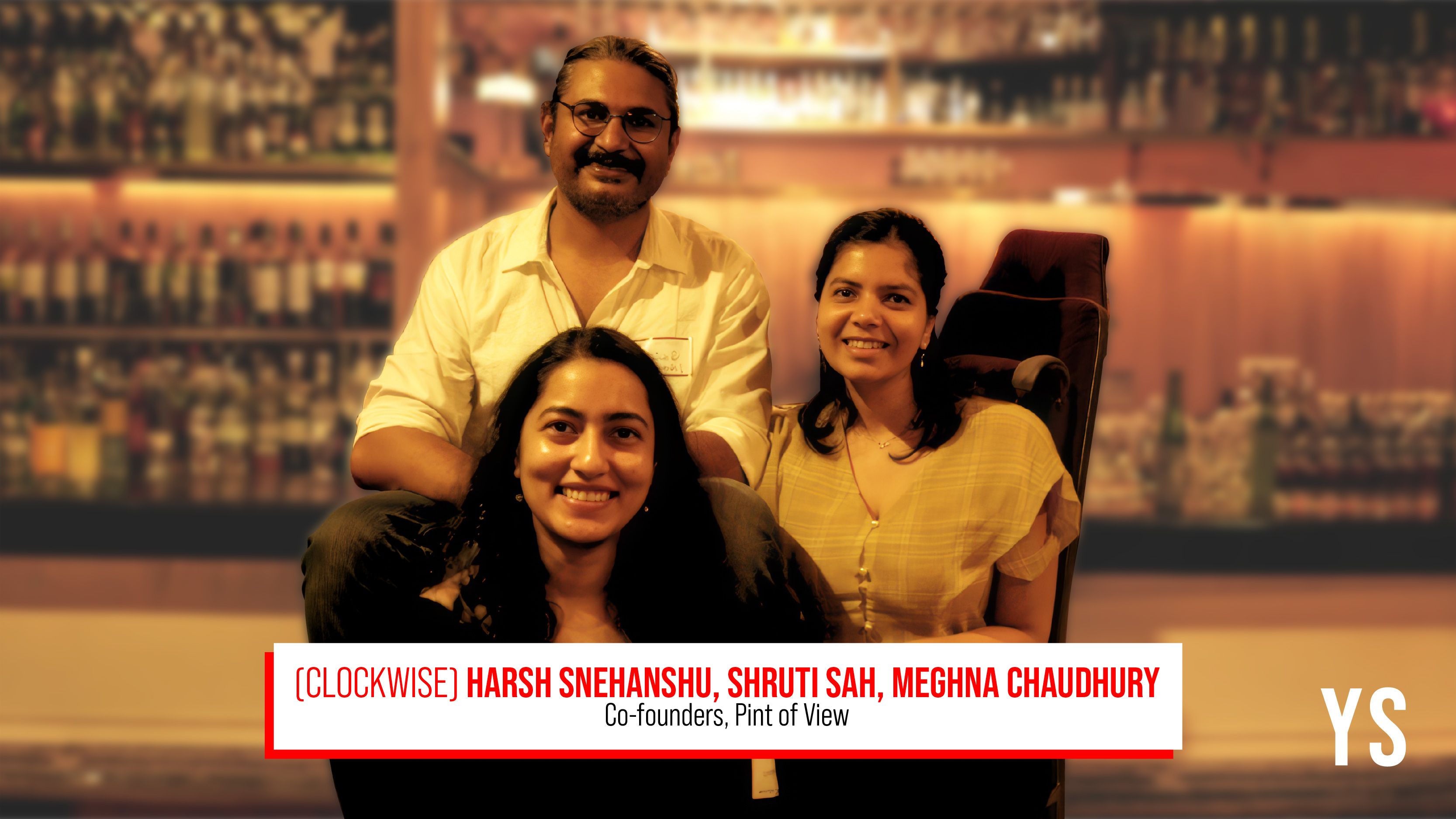
Founded in 2025 by Harsh Snehanshu, Shruti Sah, and Meghna Chaudhury, PoV was inspired by the New York-based lecture series Lectures on Tap. The founders kept hoping someone would bring the concept to India. When that didn't happen, they decided to do it themselves.
But the idea was about more than simply moving lectures out of classrooms. For the founders, it was a response to a system that often treats education as a means to an end rather than something worth pursuing for its own sake.
“We love reclaiming public spaces for the mind. This is also our sarcastic critique on the education system. There was a need to get away from the whole regimentation and power dynamic in the structure of the Indian education system. This sort of an environment where professors are interacting with adults who are snacking and drinking in front of them kind of normalises the dynamic between them,” Snehanshu says.
Sah believes many adults still want to learn, but simply lack access to the kind of learning they are interested in.
“In universities, you can’t really sit at lectures outside of your degree and hence, curiosity often goes wasted. Our lectures fix that. Expert academics are delivering lectures in neighbourhood venues with no gatekeeping. It's all about genuine curiosity, nostalgia for classroom learning, and making it easy for working adults to explore subjects they always wished they could,” she says.
The founders are no strangers to building communities. Snehanshu and Sah previously co-founded Cubbon Reads, the silent reading movement that grew far beyond Bengaluru and eventually spread to dozens of cities around the world.
PoV appears to be on a similar path. What started in Bengaluru now operates in 11 additional Indian cities and recently launched its first international chapter in London.
Also Read Bookmark this: A dating app for readers from the founders of Cubbon Reads
Learning beyond degrees
The team is selective about what makes it onto the programme. Motivational talks, self-help sessions, and personal success stories are largely avoided. Instead, the focus remains on academics and practitioners with deep expertise in their fields.
“Our attendees are between the ages of 20 and 35, with the majority at the latter end — well past the self-help age. We are creating for settled adults who would like to spend their disposable time learning about things they are interested in whether it’s science, history or literature,” Snehanshu says.
The founders prefer speakers whose work is grounded in original research or significant professional experience.
“Since we started, many therapists have approached us. But we never went ahead with any since their work is largely anecdotal. However, we are going to host our first therapist soon for a lecture on the neurobiology of addiction. But that would be more a lecture on neuroscience than on her case study,” he explains.
They have also found that interdisciplinary subjects often resonate strongly with audiences.
“A lecture on art history won’t take you through the evolution of art in Uttar Pradesh but instead it’d be about intimacy explored through the works of an artist in Varanasi, for instance,” Sah says.
One of the lecturers, Gita Chadha, Professor, School of Arts and Sciences, Azim Premji University Bengaluru, said that she enjoyed giving her lecture Talking Science, Talking Gender at PoV, in both Bengaluru and Pune editions.
“I was a bit sceptical initially thinking I'll have to tone down my content but the organisers didn't want any of that. The choices were left entirely to me. As a sociologist, I find this a space to engage with thought. I do hope many people, especially from marginal locations, will comfortably access this space,” she says.
Lecturer of another PoV session Off-roading on Mars, Nimisha Mittal, Satellite Operations Lead at Pixxel, formerly with NASA, had many favourable things to say about the audience.
“The audience is intellectually curious which makes interacting with them fun and stimulating. I often come away from PoV lectures with questions and perspectives on the topic being discussed. Sometimes they will ask questions I had previously not given much thought to.”
Also Read How a silent reading movement is forging a sense of community across cities and towns in India
From 60 attendees to sold-out venues
PoV's first event took place at Indiranagar Social on August 24, 2025. Called Bats & Booze, the lecture featured bat researcher and conservationist Dr Rohit Chakravarty, often referred to as the Batman of India.
The founders were unsure how many people would show up.
“Around 60 people showed up for the event, far exceeding our expectations. In earlier events before with previous entrepreneurial ventures, we majorly struggled to sell tickets. But I think with PoV, the messaging is far more clear and contributes to high sales,” Snehanshu says.
The concept quickly found an audience. Today, PoV regularly sells out 200-seat venues and hosts around 12 lectures every month in Bengaluru alone.
Growing city by city
As the concept expanded, the founders made a conscious decision not to build a centralised organisation.
Each city chapter operates independently. Successful events in Mumbai, Hyderabad, Chennai, or London do not share ticket revenue with the founding team.
“Lectures on Tap follows a centralised model. So they do over 21 lectures a month in New York City while only a couple of lectures in other cities. Centralising the model means more investment in resources; other curators become our employees. We don’t want that. It becomes very expensive and is very difficult to scale uniformly,” Snehanshu explains.
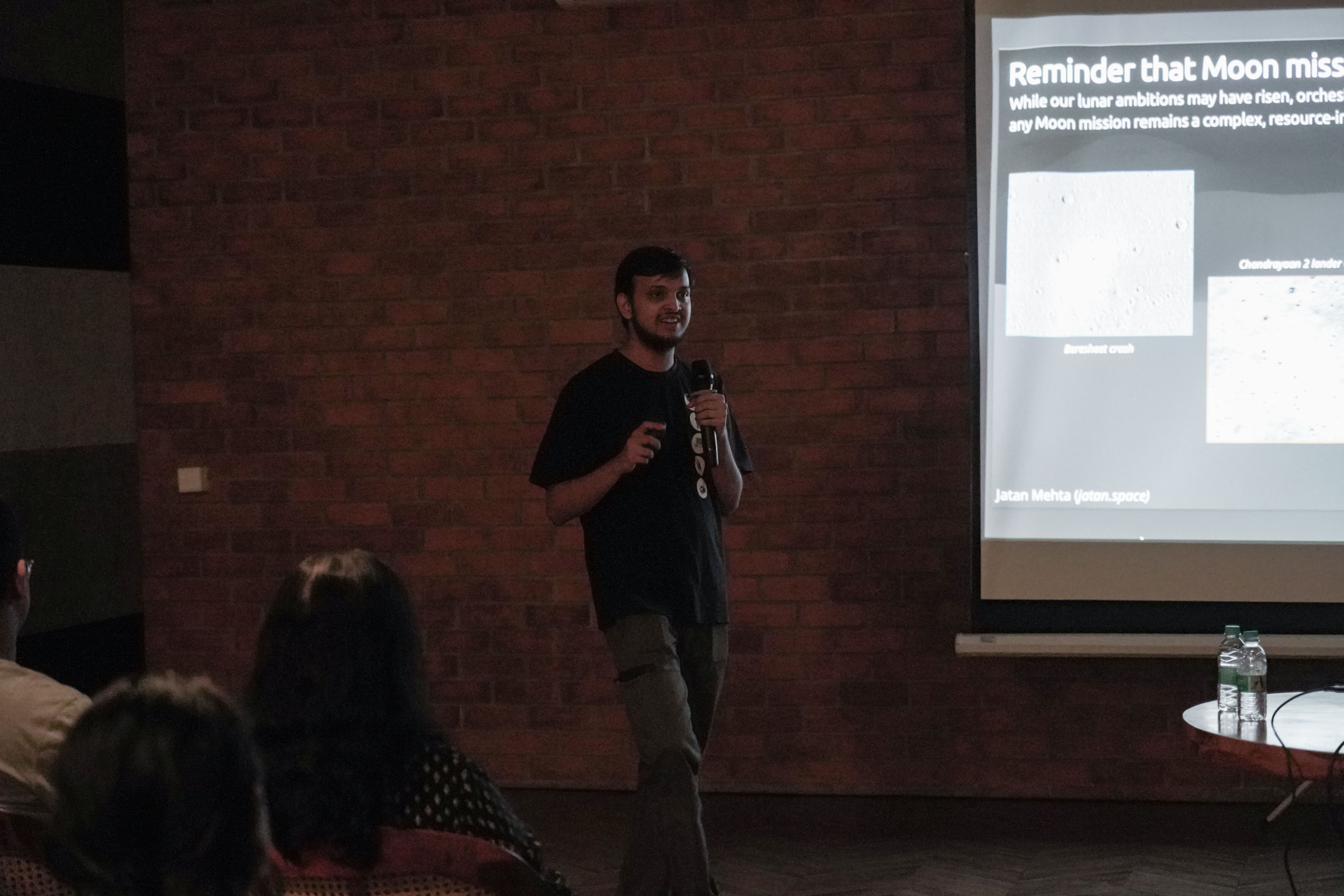
"I've found that Pint of View lectures have been effective at introducing complex topics to people without dumbing them down," says science journalist Jatan Mehta after his lecture Fly Me to the Moon.
The founders had used a similar model with Cubbon Reads, which eventually expanded to 140 chapters across 70 cities worldwide.
“Other chapters of PoV only need to pay us for the brand licensing, a nominal amount. Our earning is completely through ticket sales alone. The venue gets a cut and we pay the lecturers well too. GST is 18% and I think it’s enough for the two of us right now,” he says.
The founders are not planning to build a large team.
While they declined to share exact revenue figures, they say the Bengaluru chapter alone hosts about 12 lectures every month, with roughly 200 attendees paying an average ticket price of Rs 1,000. By their estimate, that translates to annual revenue of around Rs 2.9 crore.
What's next?
The startup's international ambitions are already taking shape.
London has hosted four events so far under the leadership of Chaudhury, while Amsterdam is next on the roadmap.
Closer home, the team is planning a lecture festival in Bengaluru.
“We are planning a two-day festival where lectures on different subjects will happen in different rooms. People can walk into anyone they would like but of course, with a beer in their hand,” Snehanshu says.
Mumbai, Chennai, and Hyderabad have emerged as some of the strongest-performing chapters outside Bengaluru.
The founders also welcome the emergence of similar communities.
“There are two-three such communities in Bengaluru itself and all seem to be doing well. What sets PoV (and every other community) apart is our curation. We need more such communities across the country to increase the market together,” Sah says.
PoV is also willing to take on subjects that sit closer to difficult conversations than comfortable ones. Recently, it hosted a lecture critiquing Dhurandhar, a session that sparked debate among attendees.
“Many professors were a bit apprehensive, but it was very well received. We don’t fear anything that could be touching on the edge of what one might consider controversial topics,” Snehanshu says.
At a time when most discussions around education revolve around employability and outcomes, PoV is betting on something simpler: that people still enjoy learning for its own sake.
Judging by the sold-out rooms, they're probably right.
Edited by Affirunisa Kankudti
Original Article
(Disclaimer – This post is auto-fetched from publicly available RSS feeds. Original source: Yourstory. All rights belong to the respective publisher.)