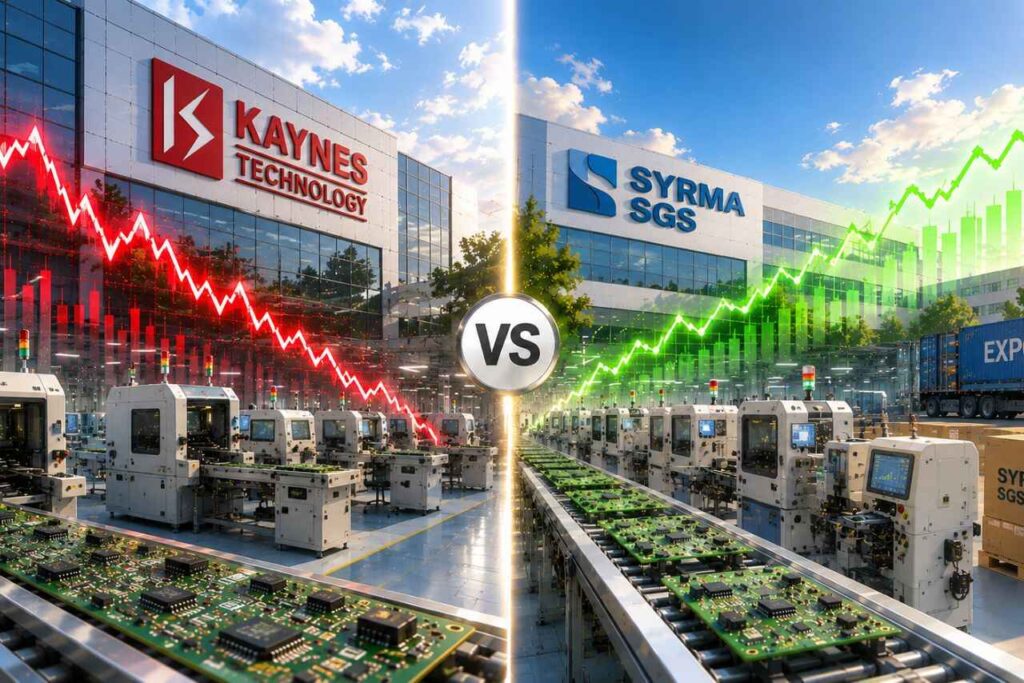
Synopsis: Kaynes Tech and Syrma SGS have delivered two very different stock market performances over the past year. But when you look beyond the share price moves, the gap between the two companies may not be as straightforward as it appears, with both offering a very different investment case.
India’s electronics manufacturing story is creating two very different stock market outcomes. Kaynes Technology India has corrected nearly 60 percent from its October 2025 high of Rs. 7,700, while Syrma SGS Technology is trading close to its all-time high of Rs. 1,188. The big question for investors is simple: is the crashed stock a better recovery bet, or is the stock near highs still the cleaner story?
Kaynes Technology and Syrma SGS both operate in India’s electronics manufacturing space, but their recent journeys look very different. Kaynes is trying to evolve from an EMS company into a more integrated electronics player with OSAT, PCB and product-driven capabilities. Syrma SGS, on the other hand, has focused on steady execution, better margins, exports, ODM growth, cash flow improvement and a stronger balance sheet.
Kaynes Technology India
Kaynes Technology is an integrated electronics manufacturing and design company with close to four decades of experience. It provides conceptual design, process engineering, integrated manufacturing and life-cycle support to OEMs. The company caters to automotive, industrial including EV, aerospace and strategic electronics, railways, medical, IT and IoT segments.
Its business is spread across OEM turnkey box build, OEM turnkey PCBA, ODM, product engineering and IoT solutions. In FY26, industrial including EV remained the largest vertical with 55 percent of revenue, followed by automotive at 25 percent, IoT, IT and others at 10 percent, railways at 6 percent, and smaller contributions from aerospace and medical. On the segment side, OEM turnkey PCBA contributed 49 percent, ODM and product engineering contributed 28 percent, and box build contributed 22 percent.
This means Kaynes is not just a simple EMS assembler. The company wants to move deeper into the electronics value chain by combining EMS, OSAT and PCB capabilities. It is also positioning itself as a design-led manufacturer, with ODM solutions in smart devices, IoT, brushless drive technology, gallium nitride technology and AR/VR through the Mustard acquisition.
What Happened In FY26?
Kaynes reported FY26 revenue of Rs. 3,626.4 crore, up 33.2 percent year-on-year. EBITDA stood at Rs. 574.1 crore, up 39.8 percent, while EBITDA margin improved from 15.1 percent in FY25 to 15.8 percent in FY26. Profit after tax stood at Rs. 363.9 crore, up 24 percent, but PAT margin declined from 10.8 percent to 10 percent.
The annual numbers still show growth, but the Q4 numbers explain why investors became cautious. In Q4FY26, revenue grew 26.2 percent year-on-year to Rs. 1,242.6 crore, but PAT declined 21.5 percent year-on-year to Rs. 91.2 crore. PAT margin fell sharply from 11.8 percent in Q4FY25 to 7.3 percent in Q4FY26. Finance cost rose 38.7 percent year-on-year to Rs. 40.9 crore, while depreciation and amortisation expense increased 221.3 percent year-on-year to Rs. 54.4 crore, reflecting the impact of ongoing expansion and new capacities.
The company also reported higher working capital intensity. Net working capital days increased from 87 days in FY25 to 125 days in FY26. Management explained that working capital days were around 122 days because of the smart meter segment, which has a different procurement and collection cycle compared to the core EMS business. They also said the core EMS working capital cycle improved from 83 days in FY24 to 53 days in FY26.
The stock correction is not because the business has stopped growing. The decline actually began after a critical report from Kotak Securities raised questions around disclosures, acquisition accounting, working capital trends and certain financial presentations.
While the company later held a detailed clarification call and strongly denied any governance concerns, the episode created uncertainty among investors and triggered a sharp derating in valuation. At the same time, the company did not fully meet the growth expectations that many investors had built into the stock, leading to concerns around execution and delivery timelines.
The pressure intensified after FY26 results, where revenue grew 33 percent year-on-year but still fell short of market expectations. Management attributed the softer-than-expected topline performance to geopolitical disruptions, customer deferments linked to the West Asia conflict, supply chain delays and product timing shifts, while reiterating that the underlying orders remained valid and executable.
As a result, investors began questioning not the opportunity size, but the pace at which Kaynes could convert its large order pipeline and ambitious expansion plans into reported revenue and profits.
Future Plans
Kaynes is now trying to become a much bigger electronics platform. Its two biggest future engines are OSAT and PCB. OSAT Unit 1 is operational, while Unit 2 is expected to commercialize by Q2FY26. The company said OSAT has revenue visibility of over Rs. 2,500 crore over the next five years. It has also launched India’s first commercial multi-chip module from the Sanand OSAT facility and is shipping IPMs to AOS, with mass production expected to ramp up.
The PCB business is another major bet. Kaynes is building high-end HDI PCB capabilities focused on complex multilayer boards for industries such as defence, aerospace and strategic electronics, with PCB Unit 1 expected to become operational by July 2026.
Management has highlighted a potential business opportunity of around Rs. 15,000 crore from PCB plus PCBA, arguing that PCB manufacturing can also pull through assembly revenues from the same customer base. According to the company, an estimated Rs. 1,500 crore of PCB revenue could potentially support nearly Rs. 13,500 crore of EMS revenue from the same customers over time.
Kaynes also wants to become more product-driven. Management said one strategic priority is to move from a traditional EMS-led organization to a differentiated ESDM and product-driven enterprise. The company wants NPD-led and value-added solutions to reach nearly 30 percent of revenue in the coming years. In Q3, management also spoke about FY28 ambition, where OSAT, PCB and EMS together could help the company target a much larger consolidated revenue base.
What Is Going Wrong?
The biggest issue with Kaynes is not lack of ambition. It is execution trust. The company has many growth engines, but investors are now asking whether the company can deliver them smoothly, on time and with clean cash conversion.
First, the stock had run ahead of delivery. When a company talks about OSAT, PCB, smart meters, ODM, Kavach, aerospace and global expansion together, expectations become huge. Second, Q4 showed pressure at the bottom line. Revenue grew, EBITDA grew, but PAT declined year-on-year. This was not the kind of result investors expected from a high-growth EMS stock.
Third, working capital remains a key watch point. The management says core EMS has improved, but consolidated working capital days have increased because of smart meters. Investors will want proof that this reverses over the next few quarters.
Fourth, Kaynes had to issue a clarification call after concerns around disclosures, Iskraemeco accounting, intangible assets, related-party disclosures, working capital and capex funding. Management said there were no governance concerns and no underlying deterioration in business. Still, once investor confidence is shaken, the company needs consistent execution to rebuild trust.
Syrma SGS Technology
Syrma SGS is one of India’s leading Electronic System Design and Manufacturing (ESDM) companies, with more than 45 years of experience in the electronics industry. The company serves over 270 customers across more than 20 countries and has built a pan-India manufacturing network with facilities in Chennai, Bengaluru, Manesar, Gurugram, Pune and Baddi, along with research and development centres in Chennai, Pune, Bengaluru and Stuttgart, Germany.
The company provides a wide range of services across the electronics value chain, including product design, printed circuit board assembly (PCBA), box-build manufacturing, rapid prototyping and tester development. In addition to its core EMS business, Syrma manufactures RFID tags and inlays, high-frequency magnetic components and electro-mechanical products.
Syrma operates across automotive, consumer electronics, healthcare, industrials, IT and railways. In FY26, consumer contributed around 30 percent of revenue, industrials contributed 29 percent, automotive contributed 24 percent, IT and railways contributed 9 percent and healthcare contributed 8 percent.
The company’s key growth drivers today are exports, automotive, industrial, healthcare and ODM. Management has repeatedly highlighted that success is not measured only through revenue growth, but also through profitability, operating cash flow generation and working capital efficiency. This focus has helped Syrma improve margins, strengthen its balance sheet and build a reputation for consistent execution across business cycles.
What Happened In FY26?
Syrma delivered a strong FY26. Total revenue stood at Rs. 4,856.9 crore, up 26.6 percent year-on-year. Operating EBITDA stood at Rs. 544.5 crore, up 68.2 percent, while operating EBITDA margin improved from 8.6 percent to 11.3 percent. Reported EBITDA stood at Rs. 582.3 crore, up 56.2 percent, with EBITDA margin improving from 9.7 percent to 12 percent.
The bottom line was even stronger. PBT rose 87.9 percent to Rs. 445.4 crore, while PAT rose 87.5 percent to Rs. 345.8 crore. PAT margin improved from 4.8 percent in FY25 to 7.1 percent in FY26. This means Syrma’s profit growth was much faster than revenue growth.
Q4 was also strong. Total revenue grew 56 percent year-on-year to Rs. 1,476.8 crore, while PAT grew 66.9 percent to Rs. 119.2 crore. Operating EBITDA grew 50.7 percent to Rs. 174.1 crore. Margins moderated sequentially because of a higher IT business mix, but the year-on-year improvement remained strong.
The segment performance was broad-based. Auto grew 39 percent in FY26, healthcare grew 36 percent, industrials grew 30 percent, and IT and railways grew 74 percent. Consumer grew only 8 percent, but that is also a lower-margin business where management is consciously not chasing aggressive expansion.
Future Plans
Syrma’s future plan is simple: continue the current momentum across revenue, EBITDA and cash flow. Management said the company had started FY26 with targets of revenue growth of around 30 percent to 35 percent, EBITDA of more than Rs. 400 crore, positive cash flow and exports crossing Rs. 1,100 crore. It ended the year with EBITDA of Rs. 545 crore, exports of more than Rs. 1,200 crore, working capital days reduced from 69 to 63 days and operating cash flow of more than Rs. 290 crore.
For FY27, management has guided for around 35 percent growth. The confidence comes from the Q4 run rate, where the company achieved revenue of around Rs. 1,477 crore, close to Rs. 500 crore per month. Management said this already implies a revenue run rate of around Rs. 6,000 crore, even before second-half growth.
Exports are another key driver. Syrma’s export revenue grew 41 percent in FY26 and contributed around 24 percent to 25 percent of operating revenue. In Q4, exports were around Rs. 372 crore, implying a run rate of around Rs. 125 crore per month. Management is targeting exports of more than Rs. 1,500 crore.
ODM is also becoming more important. Syrma’s ODM revenue increased from around 12 percent last year to about 17 percent in FY26, moving from Rs. 453 crore to Rs. 825 crore. This is positive because ODM generally improves customer stickiness and can support better margins.
What Is Going Wrong?
Syrma looks cleaner than Kaynes right now, but it is not risk-free. The first issue is valuation risk. The stock is near its all-time high, which means a lot of good news may already be priced in. Even a small disappointment in growth, margin or order inflow can hurt sentiment.
Second, Q4 margins moderated sequentially. Operating EBITDA margin fell from 12.6 percent in Q3 to 11.9 percent in Q4 because of a higher IT mix. This is not a major concern yet, but investors should not blindly assume that every quarter will show margin expansion.
Third, consumers are still a meaningful part of the revenue mix at 30 percent. Management has said consumer is a low-margin business and they are consciously sustaining it at a certain level. If this mix rises again, margins can face pressure.
Fourth, the company’s FY27 guidance of around 35 percent growth depends on continued order addition. The order book was around Rs. 6,600 crore at the end of March, but management also clarified that many orders are shorter-duration orders of three to six months. So, the order book needs continuous replenishment.
Kaynes Tech Vs Syrma SGS
Kaynes is the more exciting story, but also the more complicated one. It has bigger optionality because of OSAT, PCB, product-driven revenue, smart meters and ODM. If execution improves and working capital normalizes, the 60 percent correction could make it an interesting recovery candidate. But investors need to understand that this is no longer just a simple EMS or Semiconductor growth story. It is a high-expectation, high-capex, multi-engine execution story.
Syrma SGS is the cleaner story right now. It has delivered better cash conversion, stronger margin expansion, broad-based vertical growth, export momentum and a stronger balance sheet. It is not as flashy as Kaynes, but its FY26 performance was more predictable and easier to trust.
So where should investors look? If the investor wants a turnaround and is ready to take execution risk, Kaynes deserves attention after the sharp correction. But if the investor wants cleaner numbers, stronger recent delivery and lower drama, Syrma SGS currently looks better placed. In conclusion, Kaynes has the bigger dream, but Syrma has the better proof right now. Kaynes needs to rebuild trust. Syrma needs to justify its premium.
Disclaimer: The views and investment tips expressed by investment experts/broking houses/rating agencies on tradebrains.in are their own, and not that of the website or its management. Investing in equities poses a risk of financial losses. Investors must therefore exercise due caution while investing or trading in stocks. Trade Brains Technologies Private Limited or the author are not liable for any losses caused as a result of the decision based on this article. Please consult your investment advisor before investing.
The post Kaynes Tech Vs Syrma SGS: One Has Crashed, One Is Near Highs But Where Should Investors Look? appeared first on Trade Brains.
Original Article
(Disclaimer – This post is auto-fetched from publicly available RSS feeds. Original source: Tradebrains. All rights belong to the respective publisher.)