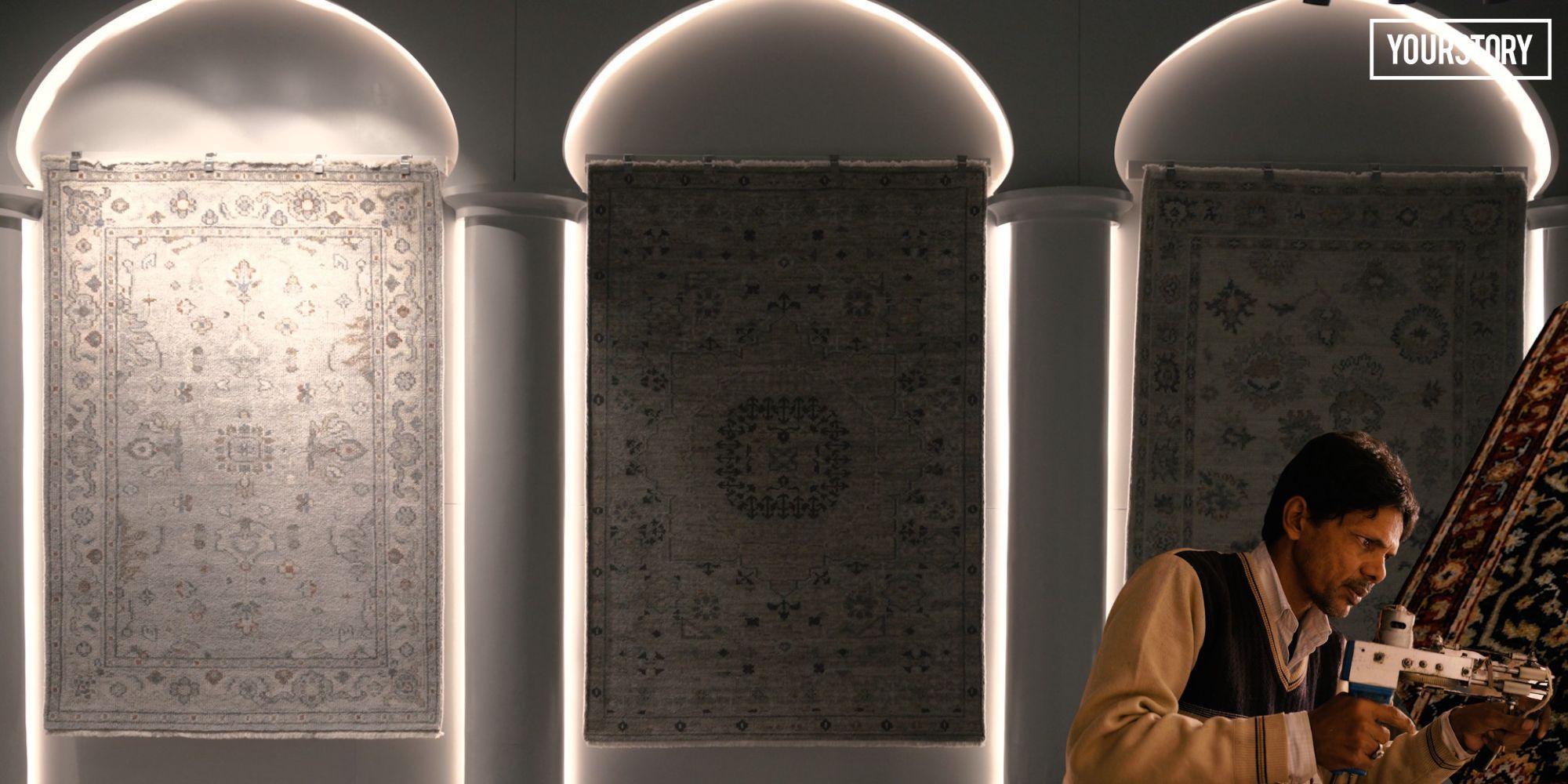
Across hotels, residences, and formal interiors, carpets and durries are chosen for their durability, texture, and finish. Each finished roll represents a coordinated production chain that connects design teams, yarn suppliers, rural weavers, washing and finishing units, and structured quality checks before dispatch.
In Uttar Pradesh, Mirzapur forms part of a major carpet-producing belt that also includes Bhadohi. Production moves between village-based weaving clusters and more centralised finishing systems within the city. Among the enterprises operating within this ecosystem is Naiman Carpets, led by Mohammad Parvez Khan, who has been engaged in manufacturing since 1995 and began direct exports in 2002.
The production framework rests on two parallel layers: weaving capacity at the grassroots level and a finishing-and-compliance system that aligns with international buyer specifications. Workforce size and output are aligned with order volumes. Alongside a core employee base, contract production enables flexible scaling in response to demand.
The workflow begins with design development, followed by sampling. Yarn is sourced, and samples are woven for buyer approval. Once approved, bulk weaving proceeds according to the selected construction and pattern. The process then transitions into finishing stages that standardise size, structure, and presentation.
For hand-knotted carpets, washing is integrated into the cycle. After washing, carpets undergo stretching to stabilise dimensions and correct alignment. Clipping refines the pile surface, ensuring uniform texture. A colour inspection follows, after which quality control clears the piece for packing.
Packing operates as a structured compliance stage. Buyer specifications determine labeling, tagging, folding, rolling, and packaging formats. Each consignment is prepared according to shipment protocols before dispatch, ensuring it meets export documentation and presentation standards.
The enterprise is export-oriented, supplying markets including the United States and Europe. Operationally, its footprint extends across multiple sites within Mirzapur, including three factories in the city, a dedicated dye house in an industrial zone, and additional contract-based production units, including in Sitapur. Production activity is also linked to clusters around the Jigna railway station area and nearby villages.
Carpets and durries are notified under the One District One Product (ODOP) programme for the Mirzapur–Bhadohi belt. Through ODOP-linked support, the business has also established a domestic-market venture and a showroom presence in Mumbai.
Mirzapur’s carpet industry functions through synchronised movement between rural weaving clusters and urban finishing infrastructure. Its continuity depends on coordinated design development, consistent order pipelines, and alignment between village artisans and export-facing compliance systems, sustaining its position in global carpet markets.
Original Article
(Disclaimer – This post is auto-fetched from publicly available RSS feeds. Original source: Yourstory. All rights belong to the respective publisher.)